Taurid Meteor Shower 2026: Halloween Fireballs, Peak Nights and Moon Timing
Taurids 2026: South Taurids peak Nov 4-5, North Taurids Nov 11-12, about 5 meteors an hour. Why sources disagree, moon timing and a viewing plan.
Key Takeaways
- Two peak nights in 2026: the South Taurids around November 4–5 and the North Taurids around November 11–12.
- Expect about 5 meteors an hour from each branch under dark skies, and roughly 10 when they overlap. This is a slow shower, not a busy one.
- The fireballs are the reason to watch. About 1% of Taurids are fireballs in a normal year. 2026 is not a swarm year.
- The Moon helps. A thin waning crescent on November 4–5 and a new Moon on November 9 keep the sky dark.
- Best time: around midnight to 3 a.m., when the constellation Taurus is high.
- Taurids 2026 at a glance
- Why websites disagree on the dates
- The Moon on the peak nights
- A simple viewing plan
- Predicted peak time in your time zone
- Five tips for a better Taurid night
- Halloween fireballs: what is real
- Comet Encke, the source
- Spiritual meaning, the honest version
- How the Taurids compare with nearby showers
- FAQ
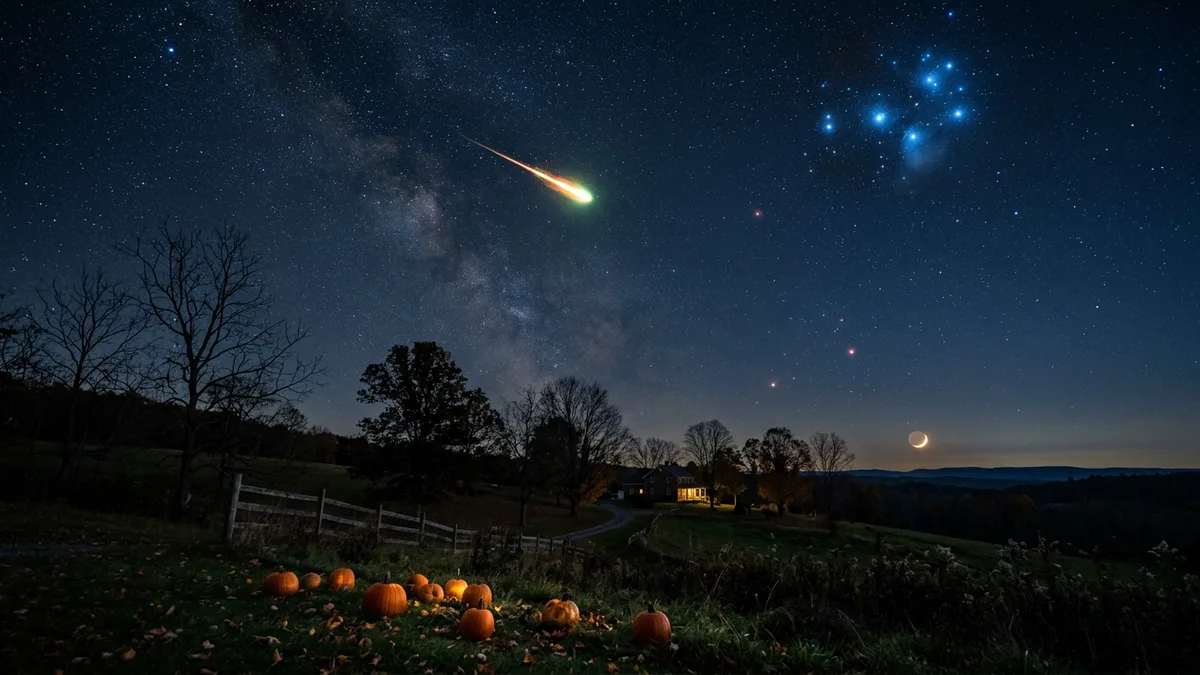
The Taurids will not give you a meteor every minute. On a good night you may count a handful in an hour. But they move slowly, they glow for a long moment, and now and then one lights up the ground like a flare. That is why people call the brightest ones Halloween fireballs.
If you have read other guides, you may have noticed that every site gives a different peak date. This guide explains why, gives you the dates that matter in 2026, and shows how to plan around the Moon.
Taurids 2026 at a Glance
| Detail | South Taurids | North Taurids |
|---|---|---|
| Active period | About September 20 – November 20 | October 20 – December 10 |
| Best night in 2026 | November 4–5 | November 11–12 |
| Early peak | October 13–14 (annual component) | None |
| Rate at peak | About 5 per hour | About 5 per hour |
| Speed | Slow, about 27–29 km/s | Slow, about 29 km/s |
| Parent | Comet 2P/Encke | Comet 2P/Encke complex |
| Radiant | Taurus, near the Pleiades | Taurus, near the Pleiades |
| Moon on the night | Waning crescent, about 25% lit | Waxing crescent, about 4% lit |
Sources: American Meteor Society 2026/2027 meteor shower calendar; EarthSky, "Taurid meteors in 2026: All you need to know" (RASC Observer's Handbook predictions); eMetN Meteor Journal outlook for October 10–16, 2026. Moon percentages come from AMS and differ by a few points between sites, depending on the hour of the night.
Why Websites Disagree on the Dates
Search for "Taurid meteor shower 2026" and you will find peaks on October 10, October 12–13, October 14, November 4–5 and November 12. They are not all wrong. They answer slightly different questions.
| Source | Date it gives | What it means |
|---|---|---|
| American Meteor Society | Oct 14 and Nov 5 (South); Nov 11–12 (North) | Two parts of the South Taurids: the annual component and the fireball-swarm component |
| EarthSky (RASC handbook) | Nov 5 at 19 UTC; Nov 12 at 18 UTC | Predicted single maxima for each branch |
| Star Walk | Oct 12–13, Nov 4–5; Nov 11–12 | Early peak, main maximum, then North Taurids |
| Royal Museums Greenwich | Oct 10 (South); Nov 12 (North) | An earlier South Taurid maximum |
EarthSky says it plainly: both branches "don't have very definite peaks" and they "ramble along" through October and November. The two streams overlap from late October into early November, so you can see Taurids on many nights.
What to do with that: treat November 4–5 and November 11–12 as your two best tries, and enjoy any clear night in between.
The Moon on the Peak Nights
| Date | Moon | Effect |
|---|---|---|
| Nov 1 | Last quarter (20:28 GMT) | Moon rises late at night; leave the early evening for watching |
| Nov 4–5 | Waning crescent, about 18–25% lit | Rises in the early morning; the dark hours before it are good |
| Nov 9 | New Moon (07:02 UTC) | No Moon in the sky |
| Nov 11–12 | Waxing crescent, about 4% lit | Almost no moonlight; sets early |
Sources quote 18%, 22% or 25% lit for November 4–5. That is a timing effect, since the Moon's lit share changes through the night. The point is the same in every case: a thin crescent that rises late.
A Simple Viewing Plan
- Pick your night. November 4–5 for the best chance of a fireball. November 11–12 for the darkest sky.
- Go out around 11 p.m. and stay until about 3 a.m. Taurus rises in the early evening and sits highest near midnight.
- Find a dark spot. A park, a field or a dark yard works. Face south-east early and south around midnight, about halfway up the sky.
- Give your eyes 20 to 30 minutes. Keep your phone dim or in red-light mode.
- Look wide. Do not stare at Taurus. Taurid meteors can appear anywhere, and their paths trace back toward the Pleiades.
- Skip the binoculars. A wide view of the sky beats a close-up.
Predicted Peak Time in Your Time Zone
The RASC handbook, quoted by EarthSky, predicts the South Taurid maximum for 19:00 UTC on November 5 and the North Taurid maximum for 18:00 UTC on November 12. Since the maximum is broad, an hour or two either way changes little. Still, it helps to know when each time falls in your day.
| Region | South Taurid maximum (Nov 5, 19:00 UTC) | North Taurid maximum (Nov 12, 18:00 UTC) | Best night to watch |
|---|---|---|---|
| UK (GMT, UTC+0) | 7 p.m. Nov 5 | 6 p.m. Nov 12 | The nights of Nov 4–5 and 5–6 |
| US Eastern (UTC−5) | 2 p.m. Nov 5 | 1 p.m. Nov 12 | The nights of Nov 4–5 and 5–6 |
| US Pacific (UTC−8) | 11 a.m. Nov 5 | 10 a.m. Nov 12 | The nights of Nov 4–5 and 5–6 |
| Central Europe (UTC+1) | 8 p.m. Nov 5 | 7 p.m. Nov 12 | The night of Nov 5–6 after midnight |
| Australia East (UTC+11) | 6 a.m. Nov 6 | 5 a.m. Nov 13 | The pre-dawn hours of Nov 5–6 |
Most of the Americas see the maximum in daylight, so the nights on either side are your best bet. Both showers keep running for weeks, which is why a clear night close to the date is fine.
US and Europe have both moved to standard time by November 5, which is why the offsets above use UTC−5, UTC−8 and UTC+1.
Five Tips for a Better Taurid Night
- Check the cloud forecast two days ahead. Clouds beat the Moon every time. If your first night is cloudy, try the next one.
- Dress for the cold. Early November nights chill you fast when you sit still. Wear one more layer than you think you need.
- Use a reclined chair. You will look up for hours, and a lying position saves your neck.
- Keep a simple count. Write down the time and each meteor you see. It turns a slow night into a small science project, and the numbers are fun to compare with the table above.
- Try a phone or camera. Use a tripod, a wide lens, a 10 to 20 second exposure and a high ISO. Point at the Pleiades and take a burst of shots for an hour. With luck, one frame catches a fireball.
What a normal Taurid hour looks like
Most hours bring zero to five meteors. They arrive without a pattern, sometimes two in a minute and then nothing for twenty. They cross the sky slowly, taking a second or more, and many leave no trail at all. The bright ones are the exceptions that stay with you.
Simple pack list
- A reclining chair or foam mat
- A warm blanket or sleeping bag
- A hat and gloves
- A red flashlight or a phone in red-light mode
- A hot drink and a snack
- A star-map app to find Taurus and the Pleiades
Halloween Fireballs: What Is Real
A fireball is a meteor brighter than the planet Venus. The Taurids produce more of them than most showers, which is why this shower gets so much attention.
- In most years about 1% of Taurid meteors are fireballs. Visual observers see around one every 20 hours.
- In swarm years the share can reach about 7%, and observers may see several in one night.
- Swarm years so far: 2008, 2015 and 2022. The next one is predicted for 2032.
- 2026 is a normal year. You have a fair chance at one bright slow meteor if you watch for several hours.
Taurid fireballs travel slowly and often break into pieces, with colors from orange to green. If you see one, report it. The American Meteor Society takes fireball reports online, and each report helps map the path.
Comet Encke, the Source
The dust behind the South Taurids comes from Comet 2P/Encke. It has the shortest orbit of any major comet, about 3.3 years, and at its closest it swings in as near the Sun as Mercury does. The next return is in July 2030.
Many scientists think Encke is a leftover piece of a much larger comet that broke up around 20,000 years ago. The pieces and the dust they shed make up what astronomers call the Encke Complex. The North Taurids likely come from a related stream, and EarthSky notes that no single asteroid may explain them.
Spiritual Meaning, the Honest Version
Meteors have carried meaning for people for a very long time, and the Halloween timing makes the Taurids feel special. Some readers treat them as a moment to let go of something before winter, which fits the Scorpio season theme of release and renewal. That is a personal ritual, and it can be a good one.
There is no scientific link between a meteor shower and events in your life. The Taurids are comet dust burning up in the air. If you want a reflection practice, use the quiet hours outside as a reason to slow down, write a note about what you want to release, and enjoy the sky.
For more on the season, see our guides to Scorpio season 2026, the November new Moon in Scorpio and Mercury retrograde in Scorpio.
How the Taurids Compare With Nearby Showers
| Shower | Peak night 2026 | Moon (AMS) | Known for |
|---|---|---|---|
| Orionids | Oct 21–22 | Waxing gibbous, 74% lit | Fast meteors from Halley's Comet |
| Southern Taurids | Nov 4–5 | Waning crescent, 25% lit | Slow fireballs |
| Northern Taurids | Nov 11–12 | Waxing crescent, 4% lit | Slow fireballs, darkest sky |
| Leonids | Mid-November | Waxing crescent, 39% lit | Fast meteors, famous storms |
| Geminids | Dec 13–14 | Waxing crescent, 15% lit | Usually the strongest of the year |
If you can only pick one, the Taurids offer the darkest skies and the best chance at a fireball. For steady counts, wait for the Geminids in December.
FAQ
When is the Taurid meteor shower in 2026?
The South Taurids are active from about September 20 to November 20 and the North Taurids from October 20 to December 10. The best nights are November 4-5 for the South Taurids and November 11-12 for the North Taurids.
How many Taurid meteors will I see per hour?
Under dark skies, about 5 an hour from each branch, and around 10 an hour when both overlap. The count is low, but the meteors are slow and often bright.
Why do websites give different peak dates for the Taurids?
The Taurids have a broad, flat maximum instead of one sharp peak. The South Taurids also have two parts, an early annual component around October 13-14 and a fireball-rich part around November 4-5, so sources pick different dates.
What are the Halloween fireballs?
Halloween fireballs is a nickname for bright Taurid meteors seen around late October and early November. Most years only about 1% of Taurids are fireballs. In rare swarm years the share can reach 7%.
Is 2026 a Taurid swarm year?
No. Swarm years brought extra fireballs in 2008, 2015 and 2022, and the next one is predicted for 2032. In 2026 expect a few fireballs on a good night, not dozens.
Will the Moon block the Taurids?
Not much. On November 4-5 the Moon is a thin waning crescent that rises in the early morning hours. The new Moon falls on November 9, so the North Taurid night of November 11-12 is almost moonless.
Sources
- American Meteor Society, "Meteor Shower Calendar 2026/2027" (amsmeteors.org/calendar): active periods, peak nights, Moon phases.
- EarthSky, "Taurid meteors in 2026: All you need to know" (earthsky.org): RASC peak predictions, fireball share, swarm years, Comet Encke.
- EarthSky, "Taurid fireballs might light up the sky around November 5" (August 30, 2026).
- Star Walk, "Taurid Meteor Shower 2026" (October 2, 2026).
- Royal Museums Greenwich, "Taurid meteor shower 2026: when and where to see it in the UK."
- Skylit Studio, "Taurid Meteor Shower 2026 UK" (October 7, 2026): Moon phase times.
- eMetN Meteor Journal, "Meteor Activity Outlook for 10–16 October 2026."
- Live Science, "Southern Taurids 2026" (September 21, 2026).