Leonid Meteor Shower 2026: Peak Night, Moon Timing and Best Time to Watch
The Leonids peak Nov 17-18, 2026 with about 10-15 meteors an hour. Peak time by time zone, first-quarter Moon timing and a simple viewing plan.
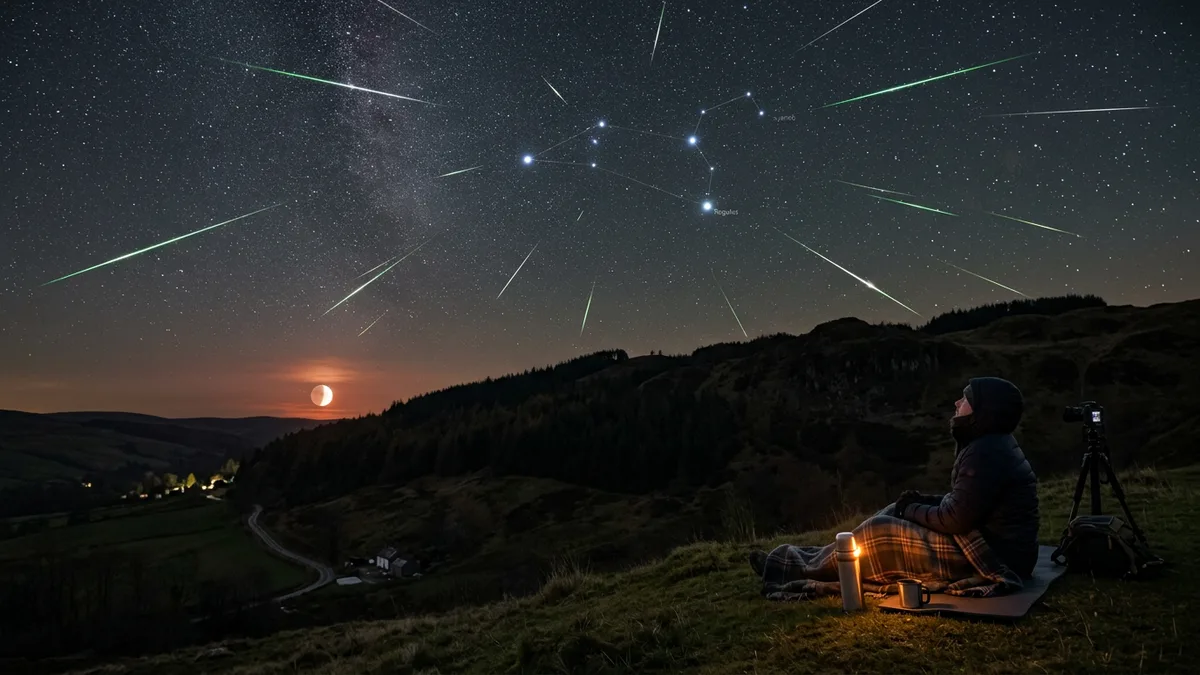
Key Takeaways
- The Leonids are active November 6–30, 2026 and peak on the night of November 17–18.
- Expect about 10–15 meteors an hour under dark skies. This is a normal year, not a storm year.
- The Moon helps more than you'd think. It is at first quarter on November 17 and sets around midnight in many places, leaving the best hours dark.
- Best plan: watch after midnight until dawn on the mornings of November 17 and 18, when Leo is high.
- Leonid meteors are fast, hitting the air at about 70 km/s (roughly 43 miles per second), and many are bright.
The Leonids have a reputation. In 1833 they turned the sky into a snowstorm of fire, with witnesses reporting more than 100,000 meteors an hour. Most years they are much calmer. But even a calm Leonid night brings fast, bright meteors, and in 2026 the Moon gets out of the way for the best part of the night.
This guide gives you the dates, the peak time in your time zone, a Moon-aware plan, and a clear picture of what you will really see.
Leonids 2026 at a Glance
| Detail | 2026 value |
|---|---|
| Active period | November 6 – 30, 2026 |
| Peak night | November 17–18, 2026 |
| Predicted maximum (IMO) | November 17 at about 23:45 UT |
| Rate at peak (ZHR) | About 15 meteors per hour, under ideal dark skies |
| Parent comet | 55P/Tempel-Tuttle |
| Radiant | Constellation Leo, near the "Sickle" and the star Regulus |
| Speed | About 70 km/s (NASA: 69.7 km/s, 43.5 miles per second) |
| Moon | First quarter on November 17 (11:48 UT) |
| Best viewing | After midnight until dawn |
Sources: International Meteor Organization 2026 Meteor Shower Calendar; American Meteor Society 2026/2027 calendar; NASA Science "Leonids"; EarthSky, January 2026. Exact peak times differ by a few hours between sources, which is normal for predictions.
Peak Time in Your Time Zone
The International Meteor Organization expects the shower's regular maximum on November 17 at about 23:45 UT. That moment arrives at very different clock times around the world, and it decides which night you should watch.
| Where | Peak moment (23:45 UT) | Best time to watch |
|---|---|---|
| London (GMT) | Nov 17, 11:45 pm | Night of Nov 17–18, after the Moon sets |
| Paris, Berlin, Tunis (UTC+1) | Nov 18, 12:45 am | Night of Nov 17–18, midnight to dawn |
| New York (EST) | Nov 17, 6:45 pm | Pre-dawn Nov 17 and Nov 18 |
| Chicago (CST) | Nov 17, 5:45 pm | Pre-dawn Nov 17 and Nov 18 |
| Los Angeles (PST) | Nov 17, 3:45 pm | Pre-dawn Nov 17 and Nov 18 |
What this means: if you live in the Americas, the exact peak falls in the evening or afternoon, when Leo is still below the horizon. Your best views come in the hours before dawn, when the radiant is high. Rates are usually decent on both sides of the peak. If you live in Europe or North Africa, the peak lands in the middle of the night, which is ideal.
The Moon on Peak Night
Moon trouble is the usual story for meteor showers, and the Orionids earlier this season had it. For the Leonids, the news is better than it first looks.
- The Moon reaches first quarter on November 17 at 11:48 UT, about 45% lit that night, according to MeteorShowerCal.
- A first-quarter Moon is high in the evening and sets around midnight. TimeAndDate lists moonset in New York at 11:55 pm on November 17. In-The-Sky.org gives 00:38 for Washington, DC. The Royal Museums Greenwich says the Moon sets just before midnight in the UK.
- The Leonid radiant rises late (about 10:54 pm in New York, per TimeAndDate) and climbs until dawn.
Want to track the lunar cycle around this? New Moon lands on November 9, a week before the shower. Our guide to the November 2026 New Moon in Scorpio has the exact time.
A Simple Viewing Plan
- Pick two mornings, not one. Try November 17 and November 18 before dawn. Cloud is the biggest risk. TimeAndDate notes that November 17–18 has been cloudy 61% of the time in New York since 2000.
- Check your moonset time. Plan to be outside from about an hour after moonset until the sky starts to brighten.
- Get away from lights. A park, a field or a dark beach beats a lit driveway. Give your eyes 20 to 30 minutes to adjust.
- Lie back and look wide. Meteors appear all over the sky. You do not need to stare at Leo, though it helps to face the east or southeast after midnight.
- Dress for the cold. November nights chill fast. A sleeping bag or thick blanket matters more than any gear.
- Stay at least an hour. Meteors come in clumps and gaps. At 10–15 per hour, you may see none for ten minutes and three in a minute.
Why the Leonids Are Famous: Meteor Storms
A meteor storm is a shower that produces more than 1,000 meteors an hour. Most astronomers use that threshold, according to EarthSky. The Leonids are one of very few showers to do it, and they have done it several times.
| Year | What happened |
|---|---|
| 1833 | The first recorded modern meteor storm. Witnesses reported over 100,000 meteors an hour. It is known as "the night the stars fell." |
| 1866–1867 | Another storm, roughly 33 years later. |
| 1899 | A storm was predicted and did not appear. EarthSky notes many astronomers saw it as a blow to public trust in astronomy. |
| 1966 | Observers in the southwestern US saw 40 to 50 meteors per second for about 15 minutes on the morning of November 17. |
| 1999–2002 | Strong displays and, in 2001, a storm with thousands of meteors an hour over North America and Hawaii. |
| 2026 | No storm expected. Normal rates of about 10–15 an hour. |
Sources: EarthSky "Leonid meteor shower: All you need to know in 2026"; American Meteor Society.
The storms line up with the comet's visits. The next close approach of the comet is in 2031, so the Leonids may get livelier in the early 2030s. Predictions are made by modeling the dust trails, and the models have improved. Still, nobody can promise a storm years ahead.
Comet Tempel-Tuttle, the Source
Every Leonid is a grain of dust shed by Comet 55P/Tempel-Tuttle. It was found by Wilhelm Tempel on December 19, 1865, and independently by Horace Tuttle on January 5, 1866. It circles the Sun about once every 33 years, which explains the storm cycle. The International Meteor Organization lists its next perihelion as May 20, 2031.
The grains are tiny, often no bigger than a grain of sand. They hit the upper atmosphere at about 70 km/s. At that speed they glow for a split second, and the fastest ones leave glowing trains that can linger for a moment. Many Leonids look green or white. Occasional brighter ones, called fireballs, are worth reporting to the American Meteor Society.
Spiritual Meaning, the Honest Version
The Leonids rise out of Leo, the Lion, while the Sun is in Scorpio. In astrology, Leo is about courage, heart and visibility, and Scorpio season is about depth and honesty. Some people use this time to set intentions, release old habits, or write down what they are ready to let go of. If that idea speaks to you, our Scorpio season 2026 guide has prompts that fit.
The honest part: meteors are space dust, and astronomy does not say they carry messages. But a quiet hour under a dark sky does real things for many people. It slows you down, gets you off your phone and reminds you how big the sky is. You do not need a prediction to benefit from that.
Five Tips for a Better Meteor Night
- Skip the telescope. Your eyes see the widest part of the sky. Binoculars and telescopes shrink the field too much.
- Turn your phone brightness to the lowest setting or use a red-light mode. White light ruins your night vision for several minutes.
- Bring something warm to drink. It keeps you outside longer, and longer is better.
- Take photos the easy way. Put your phone on a tripod, use night mode, and shoot a time-lapse or 10 to 15 second exposures toward Leo.
- Look at the other showers too. The Northern Taurids peak around November 9 and the Southern Taurids around November 5, both with low rates but occasional fireballs. They are good practice nights. See our Orionid meteor shower 2026 guide for the shower before this one.
How the Leonids Compare With Nearby Showers
The Leonids are not the busiest shower of the year, but they are one of the fastest and most colorful. This table puts the autumn showers side by side so you can decide how many nights to spend outside.
| Shower | Peak (2026) | Typical rate | Notable trait |
|---|---|---|---|
| Orionids | Oct 21–22 | About 10–20 per hour | Dust from Halley's Comet |
| Southern Taurids | Around Nov 5 | About 5 per hour | Slow meteors, occasional fireballs |
| Northern Taurids | Around Nov 9 | About 3–5 per hour | Peaks at New Moon, so the sky is dark |
| Leonids | Nov 17–18 | About 10–15 per hour | Very fast, bright, famous for storms |
Rates are approximate and come from the Old Farmer's Almanac, Sterngucker and the IMO calendar. Different sites round differently.
What a normal Leonid hour looks like
Imagine you lie out for an hour at 3 a.m. with a clear, dark sky. You might see ten or twelve meteors. They will not arrive evenly. Expect a quiet five or ten minutes, then two close together. Most will be short, white and quick. One or two may be bright enough to cast a faint shadow or leave a thin glowing trail. If you see a really brilliant one, you have likely seen a fireball.
If you only have a short window, early morning on November 18 and November 17 gives you the best chance. If clouds block both, the shower stays active for days afterward at lower rates, so a clear night on November 19 or 20 can still reward you.
Simple pack list
- A reclining chair or foam mat
- A sleeping bag or two blankets
- A hat and gloves, since November nights are cold
- A red flashlight (or a phone in red-light mode)
- A hot drink and a snack
- A weather app and a moon-phase app for your location
FAQ
When is the Leonid meteor shower in 2026?
It is active from November 6 to 30, 2026, and peaks on the night of November 17–18.
What time is best to watch the Leonids?
After midnight until dawn. The Moon is at first quarter and sets around midnight in many places, which leaves the early-morning hours dark.
How many Leonid meteors will I see?
About 10 to 15 an hour under dark skies at the peak. From a town, you will see fewer.
Will there be a Leonid meteor storm in 2026?
No. Scientists do not expect a storm this year. The parent comet is not due back until 2031.
Which direction should I look?
Look at a wide dark part of the sky. The meteors seem to come from Leo, which rises around midnight in the east and is highest at dawn, but they can appear anywhere.
Why are the Leonids so fast?
Their grains meet Earth almost head-on, at about 70 km/s. That speed makes many Leonids bright, with glowing trains.
Sources
- International Meteor Organization, "2026 Meteor Shower Calendar" (imo.net).
- American Meteor Society, "2026/2027 Meteor Shower Calendar" (amsmeteors.org/calendar).
- NASA Science, "Leonids" (science.nasa.gov/solar-system/meteors-meteorites/leonids).
- EarthSky, "Leonid meteor shower: All you need to know in 2026" (January 13, 2026).
- TimeAndDate, "Leonids Meteor Shower 2026" (timeanddate.com).
- In-The-Sky.org, "Leonid meteor shower 2026."
- Royal Museums Greenwich, "Leonid meteor shower 2026: when and where to see it in the UK."
- MeteorShowerCal, "Leonids 2026: how good is it going to be?"