Whole Sign vs Placidus Houses: What Changes in Your Birth
Compare Whole Sign, Placidus and Equal houses. Learn what each system changes in a birth chart, what stays fixed, and how to compare them consistently.
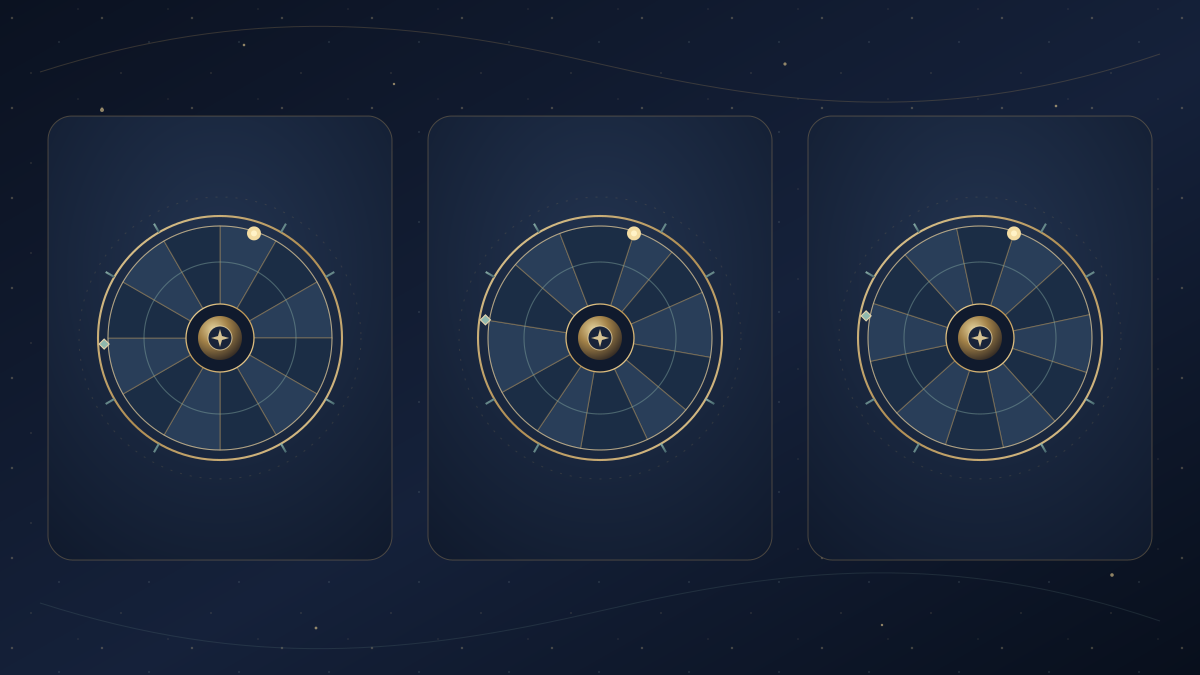
The key difference
- Whole Sign houses make the entire rising sign the first house, then assign one complete sign to each house.
- Placidus divides the chart using time-based arcs, so house sizes can be unequal.
- Equal houses begin at the exact Ascendant degree and then advance in twelve 30-degree steps.
- Switching systems can move a planet to a different house, but it does not change that planet's zodiac sign or degree when all other chart settings stay the same.
Two astrology websites can calculate the same birth date, time and place yet show a planet in different houses. That does not automatically mean one chart is broken. The websites may be using different house systems: different ways of drawing the twelve house boundaries around the same birth chart.
The most familiar comparison is Whole Sign versus Placidus, although Equal houses are worth understanding too. This guide explains the geometry in everyday language, shows why the same planet can land in two different houses, and gives you a fair way to compare charts without changing several settings at once.
- What does a house system actually do?
- Whole Sign, Placidus and Equal: the quick comparison
- How Whole Sign houses work
- How Placidus houses work
- How Equal houses work
- One planet, two house placements: a worked example
- What changes — and what does not?
- A high-latitude warning for Placidus charts
- How to compare house systems in your own chart
- Which house system should you use?
- Common questions about Whole Sign and Placidus houses
- Sources and further reading
What does a house system actually do?
A natal chart has twelve houses. In astrology, each house is used as a symbolic area of life: the first is associated with identity and presence, the second with resources, the seventh with one-to-one partnerships, the tenth with public roles and work, and so on.
A house system is the rule a chart calculator uses to mark where one house ends and the next begins. It is not the same setting as the zodiac. Tropical versus sidereal describes the zodiac framework; Whole Sign versus Placidus describes how the houses are divided. You can change one without deliberately changing the other.
The house boundaries depend on the birth moment and location. That is why a reliable birth time and birthplace matter so much when you want to compare house placements. Our step-by-step natal chart guide explains the Ascendant, houses and other chart components in context.
Whole Sign, Placidus and Equal: the quick comparison
| System | Where the first house begins | How the other houses are drawn | Typical result |
|---|---|---|---|
| Whole Sign | At 0° of the Ascendant's zodiac sign | Each following sign becomes the next complete house | Twelve equal sign-sized houses |
| Placidus | At the exact Ascendant degree | Uses divisions of the rising and setting time arcs | Unequal house widths |
| Equal | At the exact Ascendant degree | Adds 30° for every next house | Twelve equal 30° houses, offset from sign boundaries |
All three produce twelve houses, but they do not ask the same geometric question. The Swiss Ephemeris manual describes Placidus through divisions of semi-diurnal and semi-nocturnal arcs, while its Equal-house method starts from the Ascendant and steps forward in 30-degree intervals. It describes Whole Sign houses as beginning at the start of the Ascendant's sign, with each house covering a complete sign.
How Whole Sign houses work
In Whole Sign houses, the sign containing the Ascendant becomes the entire first house. The next sign in zodiacal order becomes the second house, the following sign the third, and the sequence continues around the chart until all twelve signs have been assigned.
Imagine a chart with 18° Gemini rising. Gemini is the first house from 0° to 30° Gemini. Cancer is the second house, Leo the third, Virgo the fourth, and so on. The Ascendant is still at 18° Gemini; it simply sits inside the first house rather than marking that house's starting boundary.
This is the detail that often surprises people who learned Placidus first. In Whole Sign houses, the first house begins before the exact Ascendant degree. A planet earlier in the rising sign can therefore be in the first house even though it is below the horizon in the chart's visual layout.
The Swiss Ephemeris manual notes that Whole Sign houses were used in Hellenistic astrology and remain in use in Hindu astrology; contemporary Western astrologers also use the method. The method is straightforward to map: once the rising sign is known, the sign sequence determines the house sequence. That consistency is one reason some astrologers prefer it for organising topics and techniques such as annual profections.
What happens to the Midheaven?
The Midheaven (MC) is the ecliptic degree that intersects the local meridian at birth. It is a chart angle; it is not identical to the tenth house in every house system. In Whole Sign houses, the MC does not have to be the tenth-house cusp. Its degree can fall in a different whole-sign house, while the tenth house remains the tenth sign counted from the Ascendant.
That is not necessarily a software error. Some astrologers interpret the MC degree alongside the tenth house rather than treating the two as interchangeable. The distinction is discussed in the historical overview of house division by The Astrology Podcast, episode 227.
How Placidus houses work
Placidus is a quadrant house system. It starts with the chart's angles — the Ascendant, Descendant, Midheaven and IC — and calculates the intermediate house cusps using divisions of the relevant semi-diurnal and semi-nocturnal arcs. In plain language, the method is based on the time it takes parts of the zodiac to move through the visible and invisible halves of the sky.
Because the zodiac does not rise and culminate at a uniform rate at every latitude, the resulting houses are not necessarily 30° wide. One house may span a relatively small portion of the zodiac while another is much larger. The precise cusps depend on the birth time and geographic location.
In Placidus, the Ascendant is the first-house cusp and the Midheaven is the tenth-house cusp. A sign can be split across two houses, and at some latitudes a complete sign can sit inside a house without having a cusp of its own. Astrologers call that an interception. It does not mean the sign is missing or that a person lacks the qualities associated with it; it is a feature of the house geometry in that chart.
Placidus is a valid, long-used method within modern Western astrology, but it is not the only possible way to divide a chart. Its technical definition is set out in section 6.2.1 of the Swiss Ephemeris documentation.
How Equal houses work
Equal houses are also 30° wide, but they begin at the exact Ascendant degree rather than at 0° of the rising sign. If the Ascendant is 18° Gemini, the first house runs from 18° Gemini to 18° Cancer. The second runs from 18° Cancer to 18° Leo, and every following house adds another 30°.
That means Equal and Whole Sign houses are not interchangeable, even though both use twelve equal sections. Whole Sign follows the sign boundaries; Equal follows the exact Ascendant degree.
The Swiss Ephemeris manual lists both methods separately. In a conversation on house systems, astrologers Carole Taylor and Chris Brennan also describe Equal houses as 30-degree divisions measured from the Ascendant, while noting that the MC/IC axis can fall away from the tenth/fourth house cusps in this system. See The Astrology Podcast, episode 266.
One planet, two house placements: a worked example
Return to the hypothetical chart with 18° Gemini rising and imagine a planet at 7° Cancer. Keep the same tropical zodiac and birth data; change only the house system.
- Whole Sign: Gemini is the first house and Cancer is the second, so the planet is in the second house.
- Equal: the first house runs from 18° Gemini to 18° Cancer. Since 7° Cancer is before the second-house boundary at 18° Cancer, the planet remains in the first house.
- Placidus: the placement depends on the calculated Placidus second-house cusp for the actual birth time and location. Without those inputs, it would be misleading to guess the planet's house.
This example is about the arithmetic of the systems, not a real person's chart. It shows why a planet can move from the first to the second house when you change the house system, even though its zodiac longitude is unchanged.
What changes — and what does not?
When you change only the house system in a chart calculator, the house boundaries and house placements can change. That can also change which sign appears on a particular cusp in a quadrant system, and which house an astrologer uses when interpreting a planet.
The following details do not change merely because you selected a different house system:
- The planetary zodiac signs and longitudes, provided you keep the same zodiac framework and calculation settings.
- The birth date, exact birth time and geographic coordinates entered into the calculator.
- The Ascendant and Midheaven degrees calculated from those same birth details.
- The angular distance between planets and therefore the chart's planetary aspects.
There is an important distinction: the Ascendant degree stays the same, but its role in the house grid differs. In Placidus and Equal houses it marks the start of the first house. In Whole Sign houses it is a sensitive point within the first house. The MC degree also stays the same, but it is not necessarily the tenth-house cusp in Whole Sign or Equal houses.
A high-latitude warning for Placidus charts
Birthplace latitude can expose a technical limitation that is easy to miss. Beyond the polar circles, some Placidus and Koch house cusps cannot be calculated in the usual way. The Swiss Ephemeris manual explains that its house calculation may switch to Porphyry houses in those cases and return a warning.
If you were born in a far-northern or far-southern location, read the chart calculator's notice rather than assuming the label on the settings menu tells the whole story. A displayed chart may use a fallback method for some or all house cusps. A calculator should disclose that clearly.
For an uncertain or unusual chart, compare the stated house method with the actual output and consult the software's documentation. Do not interpret a silent fallback as proof that Placidus was calculated normally.
How to compare house systems in your own chart
A useful comparison changes one variable at a time. Try this sequence:
- Use the best birth data available. Check the recorded time, birthplace and time-zone history. A rounded or uncertain birth time can affect the Ascendant and house boundaries.
- Choose one chart calculator. Keep the location, date, time, zodiac type, ayanamsa if applicable, and other settings unchanged.
- Save the first chart. Note the house system and record the house placement of the Sun, Moon, chart ruler and any planet close to a cusp.
- Switch only the house system. Compare Whole Sign, Placidus and Equal if all three are available.
- Write down what moved. Focus on the planets that changed houses and on the location of the MC. Do not assume a changed house means a changed zodiac sign.
- Read each version consistently. If a book, astrologer or technique specifies a house system, use that system for the relevant interpretation rather than mixing boundaries from several charts.
If you do not know your exact birth time, do not treat a house comparison as certain. The Ascendant and house cusps depend on the time and place. Our guide to reading a birth chart without a birth time explains what can still be interpreted and which parts deserve caution.
Which house system should you use?
There is no universally accepted winner, and house systems have been debated within astrology for centuries. The choice is best treated as a method decision rather than a search for the chart that tells the most flattering story.
- Choose Whole Sign when you want clear sign-to-house mapping and a consistent framework for sign-based techniques such as annual profections. It is also easy to explain and compare.
- Choose Placidus when you want to work within a quadrant system based on time arcs, or when you are following a book, teacher or consultation that specifically uses Placidus.
- Choose Equal when you want twelve identical 30° houses measured from the exact Ascendant degree, but do not want house boundaries locked to the zodiac sign boundaries.
If you are learning, start with one system and understand its rules before comparing another. If you are studying a traditional technique, use the house method that technique calls for. If you consult different astrologers, ask which system they use and keep that context attached to their reading.
The important thing is to avoid switching methods simply because a planet moves into a house that sounds more appealing. A consistent method makes it easier to see what the chart actually says within that system.
Common questions about Whole Sign and Placidus houses
Does changing the house system change my Rising sign?
No. With the same birth data and zodiac settings, the Ascendant degree and sign stay the same. What changes is how the first house and the other house boundaries are drawn around it.
Why is my planet in a different house on another astrology website?
The websites may use different house systems, or they may have different birth-time, location or zodiac settings. Compare the settings before deciding that one chart is wrong.
Is Placidus more accurate than Whole Sign?
There is no generally accepted scientific test that establishes one astrological house system as universally more accurate. Each system follows a different method of dividing the chart. Choose and apply a method consistently, and be clear about which one you are using.
What is the main difference between Whole Sign and Equal houses?
Both use twelve equal 30-degree houses. Whole Sign begins the first house at 0° of the Ascendant's sign. Equal begins the first house at the exact Ascendant degree, so the house boundaries do not generally coincide with sign boundaries.
Can the Midheaven be in the ninth or eleventh house?
Yes, in Whole Sign and Equal house charts the MC degree does not have to be the tenth-house cusp. The MC remains an angle and can fall in a different house, depending on the birth time and location.
Can Placidus fail for some birthplaces?
At some locations beyond the polar circles, Placidus cusps can be undefined. Some software switches to a fallback system such as Porphyry and should display a warning. Check the calculator's documentation and result.
Sources and further reading
- Swiss Ephemeris 2.10 documentation, sections 6.2 and 6.4 — technical definitions of Placidus, Equal and Whole Sign houses, plus the warning about house cusps beyond the polar circles.
- The Astrology Podcast, episode 227: Origins of the House Division Debate — historical discussion of the differences between whole-sign and quadrant approaches, including the role of the MC.
- The Astrology Podcast, episode 52: Whole Sign Houses — a detailed explanation from an astrologer who personally prefers Whole Sign; useful as a perspective, not a neutral verdict.
- The Astrology Podcast, episode 266: Aspect Patterns and Equal Houses — a discussion of Equal houses and the way the MC/IC axis can relate to the houses.
For more chart-reading foundations, continue with our natal chart reading guide and our explainer on how an ephemeris verifies planetary dates.
Editorial note: House systems are interpretive frameworks used within astrology. Their mathematical definitions can be described, but astrology's symbolic interpretations are not scientifically established predictions. Use chart readings as reflection, not as a substitute for practical, medical, legal or financial advice.