Ursid Meteor Shower 2026: Peak Time, Moonlight
The Ursids peak Dec 22, 2026 near 22:00 UTC under a nearly full Moon. Times for US, UK and Canada, realistic counts and how to watch.
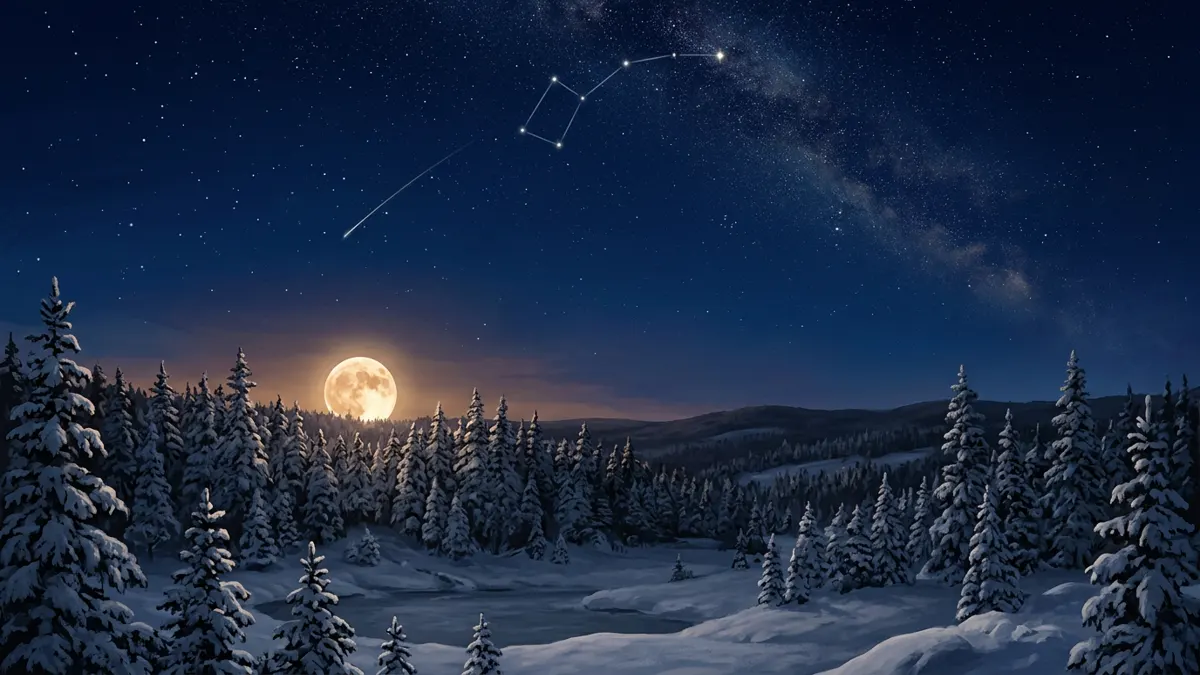
The Ursid meteor shower 2026 peaks around 22:00 UTC on December 22, which is 5 p.m. Eastern and 2 p.m. Pacific. That is daytime in North America, so your best viewing is the night around it. The catch this year is the Moon: it is almost full, so only the brightest Ursids will show.
If you go out anyway, aim for the hours before dawn on December 22 or 23, keep the Moon behind you, and expect a handful of meteors rather than a storm. Below you'll find the timing, the moonlight problem, a realistic count and a simple viewing plan.
Key Takeaways
- Active December 17–26, 2026. The International Meteor Organization (IMO) predicts the maximum near 22:00 UTC on December 22.
- The Moon is roughly 95–98% lit around the peak and reaches full on December 24 (01:28 UTC), so moonlight will wash out faint meteors.
- The usual rate is about 5–10 an hour in a good year. With this Moon, plan for a few an hour at best.
- The radiant sits in Ursa Minor and never sets for most of the US, UK and Canada, so you can watch all night.
- Sources disagree on which calendar night to call "the peak." The fix is simple: watch both December 21–22 and 22–23.
Ursids 2026 at a Glance
| Detail | 2026 value |
|---|---|
| Active period | December 17 – 26, 2026 (IMO, Royal Observatory Greenwich) |
| Predicted maximum | December 22, about 22:00 UTC (IMO) |
| Peak in other zones | 5 p.m. EST, 2 p.m. PST, 22:00 GMT |
| Typical rate | About 10 per hour (ZHR); observers usually see 5–10 |
| Parent body | Comet 8P/Tuttle |
| Radiant | Ursa Minor, near the star Kochab |
| Moon | Nearly full; full Moon at 01:28 UTC on December 24 |
| Visible from | Northern Hemisphere |
Sources: International Meteor Organization calendar; Royal Observatory Greenwich Ursid guide. Full Moon time is from our Cold Moon guide.
Which Night Should You Watch?
Different websites label the peak December 21–22 and others December 22–23. Both are right. The IMO maximum falls at 22:00 UTC on December 22. In Europe that is late evening on the 22nd. In the Americas it is late afternoon.
The American Meteor Society calls the night of December 21–22 the peak night. Time and Date lists the night of December 22–23. So your plan should be flexible.
Peak time converted for your city
| Place | Peak moment (Dec 22) | Best dark hours to try |
|---|---|---|
| New York (ET) | 5:00 p.m. | Early morning Dec 22 and Dec 23 |
| Chicago (CT) | 4:00 p.m. | Early morning Dec 22 and Dec 23 |
| Denver (MT) | 3:00 p.m. | Early morning Dec 22 and Dec 23 |
| Los Angeles (PT) | 2:00 p.m. | Early morning Dec 22 and Dec 23 |
| Toronto (ET) | 5:00 p.m. | Early morning Dec 22 and Dec 23 |
| London (GMT) | 10:00 p.m. | Evening Dec 22, then 2–6 a.m. Dec 23 |
Conversion done from the IMO's 22:00 UTC maximum. Winter time applies in all these places in December.
The Moonlight Problem
Meteor counts depend on how dark the sky is. A bright Moon turns the sky grey and hides faint streaks. With a 95–98% Moon, you lose most of the fainter Ursids.
The Moon also stays above the horizon for most of the night. The earlier Geminid shower, by contrast, gets a thin crescent. If you can only choose one December shower, read our Geminid meteor shower 2026 guide first.
What the Ursids still do well
- Their radiant is circumpolar, so it is up all night.
- They are slow (about 33 km/s), which makes each bright one easy to follow.
- They have a history of surprise outbursts. The IMO notes rates above 25 per hour on rare occasions, though these are unpredictable.
How to Watch, Step by Step
- Pick two nights. Try December 21–22 and December 22–23 if the weather allows.
- Go out before dawn. The hours before sunrise usually have the best radiant height for US cities.
- Put the Moon behind you. Face north and look about halfway up, not straight at the radiant.
- Give your eyes 20 minutes. Skip your phone screen. Use red light if you need one.
- Dress warm. It is the winter solstice, December 21 at 20:50 UTC. See our winter solstice 2026 guide for daylight by city.
- Keep a tally. Count the meteors per hour and compare with the table above.
The Astrology Around the Ursids
Astronomy and astrology are different things. The meteors have no proven effect on your life. Still, many people use this week as a quiet reflection point, and the sky has a lot going on.
The Sun enters Capricorn at the solstice (see Capricorn season 2026). Two days later, the Cold Moon comes to full in Cancer (Cold Moon guide). Capricorn and Cancer sit on the same axis: career and structure against home and feelings.
A simple reflection ritual
- Write down one thing you finished this year.
- Write one thing you want to build in 2027.
- Note one relationship or habit you want to care for more.
What each sign might focus on
| Sign | Reflection theme |
|---|---|
| Aries | Long-term goals and reputation |
| Taurus | Learning, travel, bigger views |
| Gemini | Shared money and trust |
| Cancer | Partnerships and commitments |
| Leo | Daily routines and health |
| Virgo | Joy, creativity, romance |
| Libra | Home base and roots |
| Scorpio | Conversations and short trips |
| Sagittarius | Earnings and self-worth |
| Capricorn | Identity; your season begins |
| Aquarius | Rest and letting go |
| Pisces | Friends and community |
These are traditional themes for the Sun's transit through each house from a sun-sign view. They are for reflection and entertainment, not prediction. New to charts? Start with the Big Three guide.
Photographing the Ursids
You do not need fancy gear, but you do need patience. A camera on a tripod with a wide lens works best. Point it north, include the Little Dipper and a foreground such as trees or a snowy field.
- Use a wide lens (14–24 mm) at its widest aperture.
- Set ISO 1600–3200 and 10–15 second exposures. A bright Moon means you may need shorter ones.
- Use a timer or remote so the camera does not shake.
- Take hundreds of frames in a row. Most will be empty, and that is normal.
- Keep spare batteries warm in a pocket, because cold drains them fast.
Common myths about the Ursids
- "It is a major shower." It is not. The Geminids are far stronger. The Ursids are a small, quiet shower.
- "You need to look at the Little Dipper." Not at all. Meteors can appear anywhere in the sky, so look at a wide patch.
- "The peak is one exact moment." The peak is a forecast. Real activity can arrive hours earlier or later.
- "A full Moon means no meteors." You still see bright ones, just fewer.
Bottom Line
Go out for an hour or two before dawn, expect only the brightest meteors, and enjoy the quiet. If clouds win, the next shower is the Quadrantids in early January 2027. For more dates, see NASA's meteors overview.
FAQ
When is the Ursid meteor shower in 2026?
It is active from December 17 to 26, with the peak predicted near 22:00 UTC on December 22.
Will the Moon ruin the 2026 Ursids?
It will hurt. The Moon is nearly full and up most of the night, so only bright meteors will show.
How many Ursids can I see per hour?
In a normal year, about 5 to 10 an hour from a dark site. In 2026, expect fewer.
What is the best time to watch?
The hours before dawn on December 22 or 23, facing north with the Moon behind you.
Can I see the Ursids from the Southern Hemisphere?
Not really. The radiant stays too low or below the horizon in the southern tropics.
Where do the Ursids come from?
From dust left by comet 8P/Tuttle.